
How uPVC Windows Are Manufactured: From Profile to Installation
Have you ever wondered how a uPVC window is made before it becomes part of your home?
When you look at a finished uPVC window, you see a clean frame, clear glass, smooth handles, and a neatly finished design. But behind that final appearance is a manufacturing process that involves material selection, precise measurements, profile cutting, fabrication, hardware fitting, quality inspection, and professional installation.
For homeowners planning to install uPVC windows in Hyderabad, understanding this process can help them make better purchasing decisions. It also helps explain why the quality of the profile, fabrication, glass, and installation matters just as much as the final design.
In this article, we’ll take you through the complete uPVC window manufacturing process, from the initial profile selection to the final installation at your property.
What Are uPVC Windows Made Of?
uPVC stands for unplasticized polyvinyl chloride. It is a rigid form of PVC commonly used in modern window and door systems.
Unlike traditional wooden frames, uPVC frames don’t require regular painting or polishing. They are also resistant to moisture and are available in different colours, finishes, and configurations.
A typical uPVC window system consists of several components:
- uPVC profiles: Form the main window frame and shutter structure.
- Glass: Provides visibility, natural lighting, and other performance characteristics.
- Steel reinforcement: Used in selected configurations to provide additional structural support.
- Hardware: Includes handles, hinges, rollers, and locking mechanisms.
- Rubber gaskets: Help create a seal between different window components.
- Drainage components: Help manage water within the window system.
Each component plays a role in the performance of the finished window.
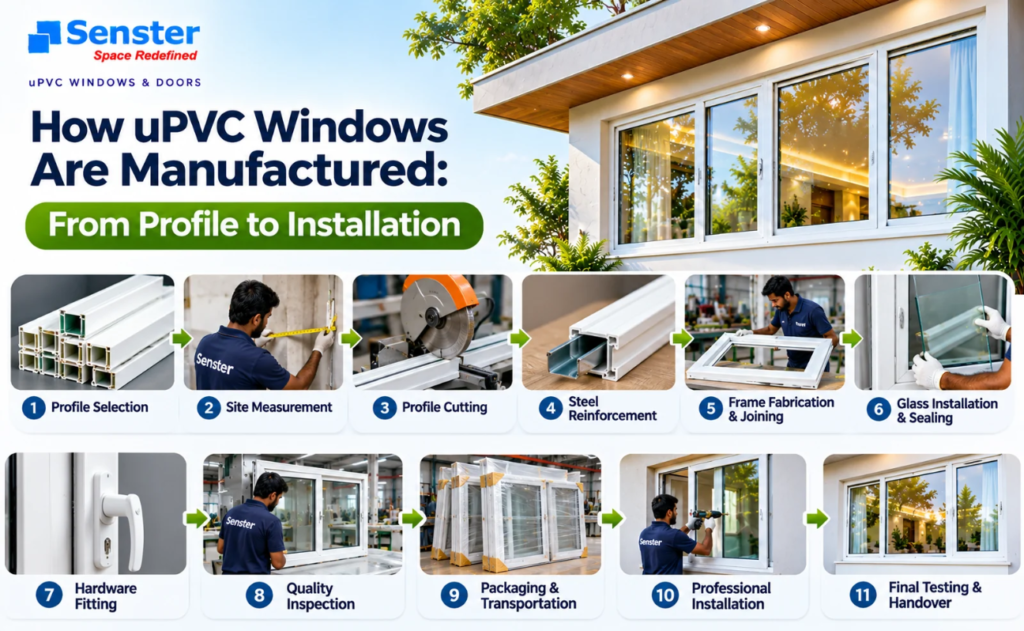
Step 1: Selecting the Right uPVC Profiles
The manufacturing process begins with selecting the appropriate uPVC profile system.
Profiles are the long, pre-manufactured sections that are cut and assembled to create the window frame and shutters.
They are available in different designs and specifications depending on the intended application.
A profile may include multiple internal chambers designed as part of its structural and thermal performance characteristics.
Before selecting a profile, manufacturers consider:
- Window dimensions
- Window configuration
- Glass requirements
- Structural requirements
- Hardware compatibility
- Building application
- Colour and finish preferences
For example, a small bedroom sliding window may require a different profile configuration from a large living room window.
Choosing a suitable profile at this stage helps ensure that the finished window is appropriate for its intended use.
Step 2: Measuring the Window Openings
Accurate measurements are essential for manufacturing uPVC windows.
Before production begins, the window openings at the property need to be measured and checked.
Measurements generally include:
- Width of the opening
- Height of the opening
- Opening depth
- Wall and sill conditions
- Required frame clearances
- Installation requirements
For new construction, measurements should be verified after the openings are ready.
For renovation projects, the existing windows and surrounding structure need to be inspected before finalizing dimensions.
Incorrect measurements can result in fitting problems, unnecessary gaps, and installation delays.
This is why professional measurement is an important part of the overall process.
Step 3: Cutting the uPVC Profiles
Once the profile specifications and measurements are finalized, the profiles are cut according to the required dimensions.
This stage requires precision because the individual sections must fit together correctly during assembly.
Depending on the window design, different profile sections are prepared for:
- Outer window frames
- Opening shutters
- Sliding panels
- Fixed sections
- Mullions and transoms
Manufacturers generally use suitable cutting machinery to achieve accurate dimensions and clean edges.
The cutting process must follow the selected system’s fabrication requirements.
Accurate cutting helps improve the fit, appearance, and assembly of the finished window.
Step 4: Steel Reinforcement Where Required
Some uPVC window configurations require steel reinforcement to provide additional structural support.
Reinforcement is particularly important for certain larger windows, doors, and configurations subject to higher loads.
The reinforcement requirements depend on:
- Window dimensions
- Profile specifications
- Design configuration
- Wind load requirements
- Manufacturer recommendations
Not every profile or opening requires the same reinforcement arrangement.
A professional manufacturer should assess the application and use reinforcement according to the system specifications.
This stage should not be treated as an optional upgrade without understanding the technical requirements of the window.
Step 5: Fabricating and Joining the Frame
After cutting and preparing the profiles, the individual sections are assembled to create the window frame and shutters.
The corners of the profiles are joined using appropriate fabrication techniques and equipment.
For many uPVC systems, heat welding is used to create strong corner joints.
The fabrication process generally involves:
- Positioning the cut profile sections.
- Preparing the joining surfaces.
- Aligning the sections correctly.
- Joining the corners using suitable equipment.
- Removing excess welding material where required.
- Inspecting the finished joints.
The quality of these joints contributes to the appearance and structural integrity of the window.
Clean, consistent fabrication is an important sign of good manufacturing workmanship.
Step 6: Installing Drainage and Ventilation Components
Windows are exposed to outdoor weather, so proper water management is important.
Depending on the system design, drainage channels and openings are provided to help direct collected water away from the window.
These openings are generally positioned according to the manufacturer’s system requirements.
The manufacturer also considers the sealing arrangement to help prevent unwanted air and water infiltration.
Proper drainage and sealing depend on the complete window design, not just the uPVC material.
During inspection, drainage openings should be checked to ensure they are correctly positioned and not blocked.
Step 7: Installing Glass and Rubber Gaskets
Once the frame and shutters are assembled, the glass is installed according to the selected configuration.
The glass specification depends on the customer’s requirements and the intended application.
Common options include:
Clear Glass: Suitable for rooms where natural light and outdoor visibility are important.
Frosted Glass: Often selected for bathrooms and areas requiring additional privacy.
Toughened Glass: Used in applications where safety glazing is required.
Laminated Glass: Can be considered for specific safety and security requirements.
Double Glazing: Uses two glass panes separated by a sealed cavity and can improve thermal and acoustic performance when properly specified.
Rubber gaskets are fitted where required to help hold the glass in position and create appropriate seals.
Correct glass fitting is important for the finished window’s appearance, stability, and performance.
Step 8: Fitting Handles, Hinges, Rollers, and Locks
Hardware is responsible for the everyday operation of the window.
The type of hardware depends on whether the window is sliding, casement, fixed, or a combination design.
Typical hardware components include:
- Handles
- Locking mechanisms
- Hinges
- Sliding rollers
- Tracks
- Latches
- Other compatible accessories
For sliding windows, the rollers and tracks should allow smooth movement.
For casement windows, the hinges and locking arrangements should suit the shutter dimensions and weight.
Hardware should be compatible with the selected profile system.
Using suitable components helps provide convenient operation and dependable locking performance.
Step 9: Quality Inspection Before Delivery
Before the finished windows leave the manufacturing facility, they should undergo appropriate quality checks.
This stage helps identify fabrication or assembly issues before the product reaches the customer’s property.
A typical inspection may include:
- Checking overall dimensions
- Inspecting corner joints
- Checking frame alignment
- Inspecting glass fitting
- Testing handles and locks
- Checking sliding movement
- Inspecting rubber gaskets
- Checking the surface finish
- Confirming the overall appearance
The manufacturer should also verify that the finished product matches the approved specifications and order details.
Quality inspection helps reduce avoidable problems during installation.
Step 10: Packaging and Transportation
Once the windows pass inspection, they are prepared for transportation.
Because finished windows contain glass and assembled frame components, careful handling is important.
Depending on the order, manufacturers may use protective packaging, corner protection, and suitable supports.
During transportation, windows should be protected from:
- Accidental impact
- Scratches
- Glass damage
- Excessive movement
- Improper stacking
Proper handling helps ensure that the windows reach the installation site in good condition.
Step 11: Professional Installation at the Site
Manufacturing is only one part of the process. The final performance of uPVC windows also depends on correct installation.
At the property, the installation team checks the openings and prepares them for fitting.
A typical installation process includes:
1. Site Inspection: The team checks the window openings and surrounding structure.
2. Frame Positioning: The window frame is positioned correctly within the opening.
3. Alignment: The frame is checked for proper alignment and level.
4. Fixing: The frame is secured according to the selected system’s installation requirements.
5. Sealing: Suitable sealing materials are applied around the frame to help prevent air and water infiltration.
6. Shutter Installation: Opening panels are fitted where applicable.
7. Hardware Testing: Handles, locks, rollers, and hinges are checked.
8. Final Inspection: The installation team checks the overall finish and operation.
Proper installation is essential because even a well-manufactured window can develop problems if it is incorrectly fitted.
Step 12: Final Testing and Customer Handover
After installation, the windows should be tested before the project is considered complete.
The final inspection generally includes:
- Smooth opening and closing
- Correct locking operation
- Proper alignment
- Secure glass fitting
- Visible seal inspection
- Clear drainage openings
- Clean frames and glass
- Overall installation finish
The customer should also receive basic maintenance instructions and applicable warranty information.
This helps homeowners understand how to care for their new windows.
Different Types of uPVC Windows Manufactured
The manufacturing process may vary depending on the selected window configuration.
Here are some commonly available types.
1. uPVC Sliding Windows
Suitable for apartments and compact spaces.
Sliding windows operate horizontally along tracks. They are often selected when there is limited space for shutters that open inward or outward.
2. uPVC Casement Windows
Suitable for rooms where ventilation is important.
Casement windows operate using hinges and can provide a wider opening depending on the design.
3. uPVC Fixed Windows
Suitable for natural lighting and outdoor views.
Fixed windows do not open and are commonly used in staircases, feature walls, and large glass openings.
4. uPVC Combination Windows
Suitable for customized architectural requirements.
Combination windows bring together fixed and opening sections within a single frame.
How Long Does uPVC Window Manufacturing Take?
The manufacturing timeline depends on the size of the project, number of windows, profile availability, design complexity, and production capacity.
A small residential order may take less time than a large villa or commercial project involving customized window configurations.
The overall project timeline generally includes:
| Stage | What happens |
|---|---|
| Initial discussion | Requirements and designs are finalized. |
| Site measurement | Window openings are measured and verified. |
| Quotation approval | Specifications and pricing are confirmed. |
| Manufacturing | Profiles are cut, assembled, and finished. |
| Quality inspection | Finished windows are checked. |
| Transportation | Windows are delivered to the property. |
| Installation | Frames and shutters are fitted and tested. |
Ask your manufacturer for an estimated schedule based on your actual project rather than relying on a general timeline.
Factors That Affect uPVC Window Manufacturing Cost
The cost of manufacturing uPVC windows depends on several factors.
Profile Specifications
Different profile systems have different specifications and pricing.
Window Dimensions
Larger windows generally require more profile material and glass.
Window Design
Sliding, casement, fixed, and combination windows have different fabrication and hardware requirements.
Glass Selection
Clear, frosted, laminated, toughened, and double-glazed options may have different costs.
Hardware
Handles, locks, rollers, and hinges influence the overall price.
Reinforcement
Certain window configurations require additional reinforcement.
Installation
Transportation, site preparation, fixing, sealing, and finishing may affect the final project cost.
For an accurate estimate, request a detailed quotation after your site measurements and specifications have been finalized.
Why Manufacturing Quality Matters for Hyderabad Homes
Hyderabad experiences hot summers, dust, and seasonal rainfall. These conditions make proper product selection and installation important.
A well-specified uPVC window system can offer several practical advantages.
Moisture Resistance: uPVC is resistant to moisture and does not rot like untreated wooden frames.
Relatively Low Maintenance: Frames generally don’t require regular painting or polishing.
Indoor Comfort: Suitable profiles and glazing can contribute to improved thermal performance.
Noise Reduction: Appropriate glazing and sealing may help reduce external noise.
Modern Appearance: Different configurations and finishes can complement contemporary architecture.
However, the performance of a window depends on its complete specification, including the profile, glass, hardware, sealing, and installation.
How to Identify a Reliable uPVC Window Manufacturer
Before selecting a manufacturer, don’t focus only on the price or appearance of the finished product.
Check the following:
- Profile specifications and material quality
- Manufacturing and fabrication facilities
- Experience with different window designs
- Glass and hardware options
- Quality inspection procedures
- Accurate site measurement
- Professional installation
- Written warranty details
- After-sales service
- Previous completed projects
A reliable manufacturer should be able to explain the complete process, from profile selection to final installation.
Why Choose Senster Building Systems?
At Senster Building Systems, we provide uPVC windows and doors in Hyderabad for apartments, villas, independent houses, and commercial projects.
We understand that every building has different requirements. The right window system depends on the opening dimensions, architectural design, ventilation needs, glass specifications, and budget.
Our team can help customers explore suitable options, including:
- uPVC sliding windows
- uPVC casement windows
- Fixed uPVC windows
- Combination windows
- uPVC sliding doors
- uPVC balcony doors
We also provide aluminium windows and doors for projects where aluminium may be more appropriate.
Our approach focuses on understanding project requirements, selecting suitable systems, accurate measurement, professional installation, and customer support.
Final Thoughts
The manufacturing of uPVC windows involves much more than cutting a few profiles and fitting glass.
It is a complete process that includes profile selection, accurate measurement, cutting, reinforcement where required, frame fabrication, glass installation, hardware fitting, quality inspection, transportation, and professional installation.
Every stage contributes to the appearance, functionality, and long-term performance of the finished window.
If you’re planning to install new windows in your home, take time to understand how they are manufactured and what specifications are included in your quotation.
A well-manufactured window combined with correct installation can make a meaningful difference to your home’s comfort, appearance, and everyday usability.
Looking for uPVC Windows in Hyderabad?
Senster Building Systems provides uPVC windows and doors for residential and commercial projects in Hyderabad.
Address: Survey No. 126, Dommarapochampally, Gandimaisamma, Medchal-Malkajgiri District, Hyderabad, Telangana – 500043
Phone: +91-8096267091 / +91-9959216869
Email: hello@senster.in
Contact Senster Building Systems to discuss your requirements, explore suitable window designs, and request a project-specific quotation.